Showing posts with label BHARTIYA JANATA PARTY. Show all posts

Tuesday, 10 September 2019

Gujarat govt goes lenient, slashes new traffic violation fines by 90%

The new provisions will come into force in Gujarat from September 16, chief minister Vijay Rupani said
Gujarat govt goes lenient, slashes new traffic violation fines by 90%
Current Affairs: The BJP-ruled Gujarat government on Tuesday announced a drastic cut in the penalties for traffic violations even as the Centre is justifying the steep fine amounts under the amended Motor Vehicles (MV) Act.
In some cases the reduction in the state is as steep as Rs 1,000 from Rs 10,000. On July 31, Parliament passed the Motor Vehicles (Amendment) Bill, 2019. But some states, especially those ruled by non-BJP parties, have opposed its stringent provisions and not implemented them yet.
The amended Central MV Act provides for a fine of Rs 1,000 for driving a two-wheeler without helmet; in Gujarat traffic fine will be Rs 500, Chief Minister Vijay Rupani announced here. The penalty for the offence in the state, currently, is a mere Rs 100.
While the Central law has proposed a fine of Rs 1,000 for pillion rider not wearing helmet, this provision will not be implemented at all in Gujarat, Rupani said. Further, one can produce driving license or other documents in digitised form after storing them in ‘DigiLocker’ app, he said….

Thursday, 17 January 2019

Data shows BJP bagged 92% of corporate donations to political parties

ADR data for FY18: Contribution peaked in the run-up to the Assembly polls in Himachal, Gujarat
Donation
Economy News: In 2017-18, corporates contributed as much as 12 times more money to the coffers of the Bharatiya Janata Party (BJP) than to those of the other six national parties combined.
The BJP received 93 per cent of all donations of above Rs 20,000 made to the country’s six national political parties in 2017-18 by business groups and individuals, according to a report by election watchdog Association for Democratic Reforms (ADR). Donations from corporates formed 91.58 per cent of total donations declared by the BJP, the rest being from individual donors, the ADR analysis of details submitted to the Election Commission by national parties has revealed.
The seven national parties are the Bhartiya Janta Party, Congress, Bahujan Samaj Party (BSP), Nationalist Congress Party (NCP), Trinanmool Congress, Communist Party of India (CPI) and Communist Party of India (Marxist). The BSP declared that it did not receive any amount in excess of Rs 20,000. The current law mandates political parties to declare the identity of all who donate more than Rs 20,000.
Total contributions declared by national parties in 2017-18 was Rs 469.89 crore from 4,201 donations. The BJP declared receiving Rs 437.04 crore from 2,977 donations, while the Congress got Rs 26.658 crore from 777 donations, or 5.67 per cent of total donations above Rs 20,000..
Contain Source by Business Standard or BS

Thursday, 11 May 2017

Kashmiri army man’s killing needs an honest appraisal of the ground reality

As the months pass, violence is claiming an ever-widening compass of victims in Kashmir

1494390916-2285
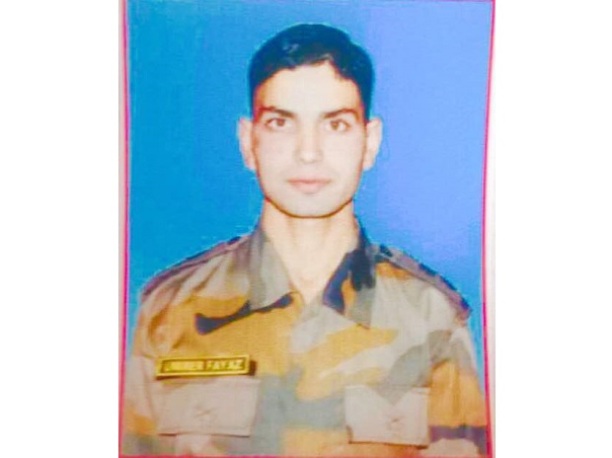
On May 9Umar Fayaz Parraya 22-year-old army officer from Kulgam district in South Kashmir, was abducted and killed. He was home on a fortnight’s leave from the Akhnoor sector in Jammu, where he was posted. According to local journalists, he had already spent 12 days at his home in Sudsona village. Parray was at his cousin’s wedding in neighbouring Shopian district when he was kidnapped.
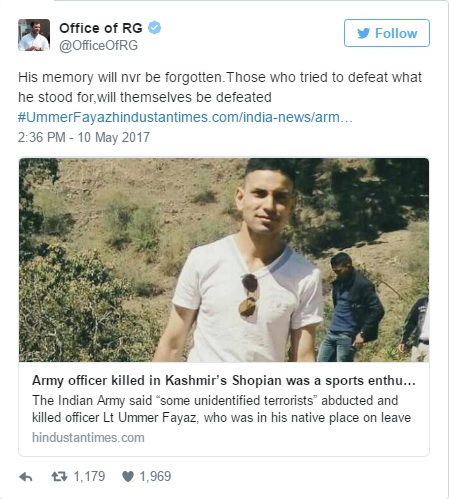
As news of the killing broke on Wednesday, Parray’s name was swept up in a social media storm. His death was condemned by a range of public figures, from Defence Minister Arun Jaitley to Jammu and Kashmir Chief Minister Mehbooba Mufti to Congress Vice President Rahul Gandhi.
UMMAR
JAITLEY
There was renewed criticism of “stone-pelters”, “terrorists” and “anti-nationals”. There were tributes holding him up as a model Kashmiri, in contrast to Burhan Wani, the Hizbul Mujahideen commander whose death last July triggered a summer of violent protest. It was reminiscent of the split screens on television last year, showing Kashmiri Indian Administrative Service officer Shah Faesal on one side and Wani on the other, until Faesal himself protested this formulation in a strongly worded opinion piece.
This time, anger was fuelled by reports that there had been stone-pelting on the funeral procession bearing Parray’s body. These reports were later refuted by journalists who visited the spot. (READMORE…)

Monday, 17 April 2017

AAP vs BJP: Delhi's local polls arouse national interest

While BJP has made the elections a matter of prestige, AAP's national prospects hinge on these

 http://www.business-standard.com/article/politics/aap-vs-bjp-delhi-s-local-polls-arouse-national-interest-117041600731_1.html
#LATEST| A few days before the Punjab Assembly elections, parties in opposition, mainly the Congress, managed to plant an element of doubt in voters’ minds about the Aam Aadmi Party’s (AAP’s) performance in Delhi. 
The Opposition ran a concerted campaign that the Arvind Kejriwal-led Delhi government had failed to deliver on most governance issues, beside being at loggerheads with the Bharatiya Janata Party (BJP) government at the Centre. Many were persuaded that the Narendra Modi government would deny funds and resources to Punjab if AAP won the state.
This took the wind out of AAP’s sails and the party lost its strong momentum before the polling.
All eyes are now trained at the elections, on April 23, to the three municipal corporations in Delhi. Currently, the BJP rules all the three — East, South and North civic bodies.
These local bodies are mainly tasked with the work of clearing garbage, primary education and primary health care. And, the elections are being keenly observed by both AAP sympathisers and other parties across the country.
Both the AAP supporters and those on the fence would take the results as a referendum on the AAP performance in Delhi. Political parties not currently part of the BJP-led National Democratic Alliance (NDA) government at the Centre would see it as either a rise or fall of another opposition force. Loss for AAP is likely to further compel regional satraps to form a rainbow coalition against the NDA government before the 2019 general election.
AAP leaders agree a win in the civic elections would consolidate their position. “AAP is an alternative party. A win in these elections will further strengthen the faith of AAP supporters,” says Dilip Pandey, convenor of its Delhi unit.
There is a sense in the AAP leadership that the BJP and the Congress are in a ‘friendly fight’ in the Delhi elections, aimed to keep their party out. A similar rumour kept circulating during the Punjab Assembly election. “The Congress should have highlighted the BJP’s failure in the civic bodies. The BJP is fighting the elections not on the basis of their achievements in the past 10 years but on mudslinging. The BJP is scared, as its councillors are facing anti-incumbency, and they have failed,” alleges Pandey.
The BJP has made the elections a matter of prestige, involving the party’s national president Amit Shah and several cabinet and state chief ministers. The party has replicated the Gujarat style of election fighting by denying poll tickets to most of its incumbent councillors. The BJP is expecting to win on Prime Minister Modi’s popularity, similar to its success in the recent elections in five states. The aim would be to contain AAP to a minimum, as happened with the Bahujan Samaj Party and the Samajwadi Party in Uttar Pradesh.
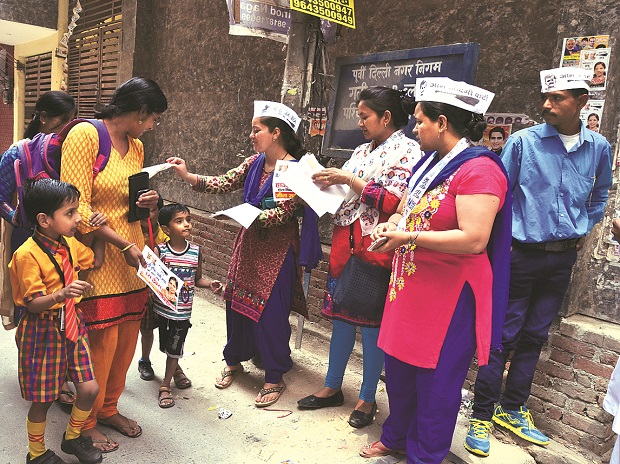
The BJP’s aggressive stance has forced AAP on the back foot. Instead of riding on Kejriwal’s popularity, the party has formed around 4,000 teams for door-to-door campaigning, is to reach at least four million households. These teams are to explain to people that most of the promises made before the Delhi assembly election in 2015 have been fulfilled. These include reducing power bills by half, providing free water supply up to 20,000 litres a month and free education loan up to Rs 10 lakh. 
The AAP government also raised the minimum wage for unskilled workers from Rs 9,724 to Rs 13,350 a month, for semi-skilled workers from Rs 10,764 to Rs 14,968 and for skilled workers from Rs 11,830 to Rs 16,182. The pension for senior citizens, persons with disability and widows was increased by Rs 1,000 a month. 

Monday, 6 March 2017

Uttar Pradesh is the BJP's to lose. Or is it?

The final phase voting will be held on March 8, while the counting will be held on 11 March

 PM Modi's road show in Varanasi

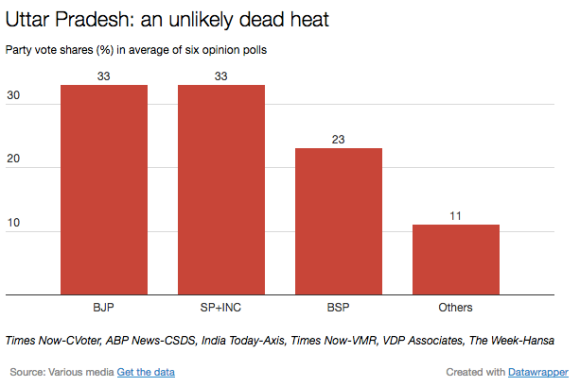
As counting day on 11 March approaches, it seems as difficult as ever to gauge which way the political wind in Uttar Pradesh (UP) is blowing. Even before the campaign began, pre-election opinion polls offered little help, showing the Bharatiya Janata Party (BJP) and the Samajwadi Party (SP)-Congress alliance neck and neck, with the Bahujan Samajwadi Party (BSP) lagging.
Screen Shot 2017-03-06 at 6.32.02 PM.png
We know from elections in Delhi (2015), Bihar (2015) and West Bengal (2016) that a dead heat in pre-election polls is almost never a good predictor of the eventual outcome.
So what are the BJP’s chances of pulling off a win? If the starting point is the BJP’s historic 2014 victory, its lead seems unassailable. The BJP won 328 of 403 assembly segments, including 253 with more than 40% of the vote, and as Praveen Chakravarty states, for it to win fewer than 200 seats even if “two of the opposition parties get together, the BJP would still have to lose more than 10% of its voters”.
But if the baseline is the 2012 state election, the SP-Congress alliance begins to look formidable. As Karthik Sashidhar writes: “it will take a 7 percentage point swing from the 2012 elections to pull the Samajwadi Party-Congress alliance below the halfway mark”. While this sounds big, it is well within the realm of possibility: in 2014, the SP dropped seven percentage points from its 2012 tally, giving the BJP a sweep in that four-cornered contest.
So which is it? The opinion poll numbers suggest that 2014 is, in fact, the appropriate baseline: 33% represents a near doubling of the BJP vote in the past three state elections and a decisive break from UP’s two-party dominant system. Yet it is undeniable that the SP-Congress alliance has raised the threshold of votes any party needs to attain a majority, transforming the contest from a seeming BJP walkover to a tough fight.

14th BRICS summit to review current global issues, reach key agreements

  At the   14th BRICS summit   which is to be hosted by China in a virtual mode on 23-24 June, the member nations will review the current gl...