Showing posts with label government. Show all posts

Tuesday, 26 April 2022

Alwar temple demolition: Raj govt suspends 3 officials including SDM

 Amid the row over the 300-year-old Shiva temple demolition in Alwar, the Rajasthan government suspended three officials including a Sub-Divisional Magistrate (SDM) on Monday.

Amid the row over the 300-year-old Shiva temple demolition in Alwar, the Rajasthan government suspended three officials including a Sub-Divisional Magistrate (SDM) on Monday. The suspended officials include Rajgarh SDM Keshav Kumar Meena, Rajgarh Municipality Board’s chairman Satish Duharia and Executive Officer (EO) of the Nagar Panchayat Banwari Lal Meena. A 300-year-old Shiva temple was demolished using bulldozers at Sarai Mohalla, Rajgarh in the Alwar district last week. Besides the Shiva temple, 86 shops and homes were demolished with bulldozers in Rajasthan’s Alwar district on Sunday, to clear the way for a road.

Earlier on Monday, a PIL was filed in the Rajasthan High Court against the demolition of a 300-year-old Shiva temple in Alwar, in which Chief Minister Ashok Gehlot along with District Collector, Sub Divisional Magistrate, Executive Officer, Municipality and others have been made the party.


Monday, 3 January 2022

'Bulli Bai' app case: NCW asks Delhi Police to register FIR in the matter

 The National Commission for Women (NCW) has written to Delhi Police Commissioner regarding the Bulli Bai app case to immediately register FIR in the matter.

Photo: Shutterstock

The National Commission for Women (NCW) has written to Delhi Police Commissioner regarding the Bulli Bai app case to immediately register FIR in the matter. NCW in the letter dated January 2 said that after the Sulli deal outrage this is another incident reported of the same portal GitHub which is “condemnable in the strongest possible words”.

“The Commission is extremely anguished and distressed with the abovementioned crime against a woman on cyber space. You are, therefore, required considering the gravity of the matter to immediately register FIR in the matter,” reads NCW’s letter to Delhi Police Commissioner Rakesh Asthana.

“The process must be expedited so that the alleged crime is not again repeated by the same portal ‘GitHub’. It is disappointing that even after the lapse of so many months since the “Sulli Deals” outrage, there has been no concrete action taken in the matter which is utterly unfortunate and concerning. The action taken in the matter in both the cases must be apprised to the Commission at the earliest.”..continue..

Monday, 27 December 2021

'Extremist elements in Afghanistan pose threat to Pakistan': Pak minister

 Federal Minister for Information and Broadcasting Fawad Chaudhry on Monday said that ‘extremism in Afghanistan is a threat to Pakistan”.

Pakistan flag

Federal Minister for Information and Broadcasting Fawad Chaudhry on Monday said that ‘extremism in Afghanistan is a threat to Pakistan”. “Women are not allowed to travel alone in Afghanistan, and they cannot go to school as well,” Chaudhry said while addressing the inaugural ceremony of a photo exhibition on the life of Quaid-e-Azam Muhammad Ali Jinnah at the Pak-China centre, reported Geo News.

Pakistan is blamed globally for supporting terrorism and helping the Taliban. The federal minister’s crocodile tears came a day after the Afghan Taliban said that women seeking to travel long distances should not be offered transport unless they are accompanied by a close male relative. The guidance, issued by the Ministry for the Promotion of Virtue and Prevention of Vice, also called on all vehicle owners to offer rides only to those women wearing hijabs, reported Geo News.

Tuesday, 18 August 2020

India-Japan summit likely next month, to focus on boosting trade ties

The annual summit between Prime Minister Narendra Modi and his Japanese counterpart Shinzo Abe is likely to take place early next month
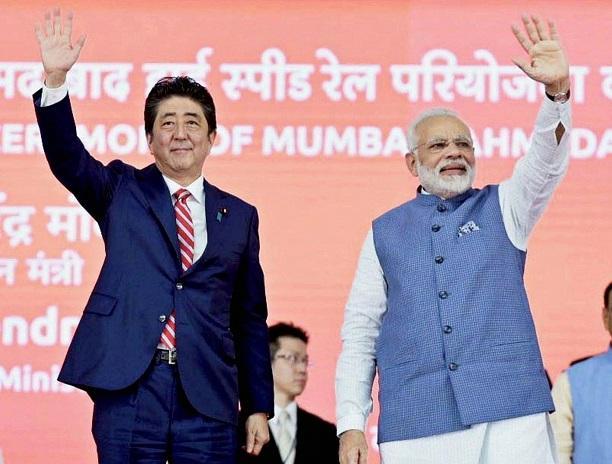
PM Modi and Japanese PM Shinzo Abe lay the foundation stone for India's first high-speed rail project on Thursday in Ahmedabad. Photo: Twitter (@ANI)

The annual summit between Prime Minister Narendra Modi and his Japanese counterpart Shinzo Abe is likely to take place early next month and its broad focus would be further expansion of the already close strategic and trade ties between the two countries, people familiar with the development said on Monday. Abe's visit to India for the annual summit in Guwahati in December last year was cancelled in the wake of massive protests rocking the capital city of Assam over the amended citizenship law.

The next month's summit will be a virtual one and preparations are underway for it, the people cited above said. In the India Japan summit, the two sides are expected to seal a military pact on reciprocal access to military bases for logistics support, they said.

The pact will allow militaries of the two countries to use each other's bases and facilities for repair and replenishment of supplies besides facilitating scaling up of overall cooperation. In the summit, the two sides are expected to review the entire spectrum of bilateral defence ties, including the long-pending issue of supply of the US-2 amphibious aircraft by Japan to India.

Sunday, 23 February 2020

Britain starts hearing US case for extraditing Wikileaks’ Julian Assange

A UK court ruled in February 2011 that Assange could be extradited back to Sweden to stand trial
Julian Assange
Britain on Monday starts hearing Washington’s extradition request for WikiLeaks founder Julian Assange in a test case of media freedoms in the digital age and the limits of US justice. A ruling against Assange in the case could see the 48-year-old Australian jailed for 175 years if convicted on all 17 US Espionage Act charges and one count of computer hacking he faces. Each stems from his site’s release in 2010 of a trove of classified State Department and Pentagon files detailing the realities of the US campaigns in Afghanistan and Iraq.
One video from 2007 showed an Apache helicopter attack in which US soldiers gunned down two Reuters reporters and nine Iraqi civilians in broad daylight in Baghdad. The files also disclosed the secret identities of diplomats and government agents in hostile environments — as well as locals who risked their lives by cooperating with the United States. These names were redacted by the Western newspapers with which WikiLeaks initially worked.
But a falling out with their editors prompted Assange to release hundreds of thousands of files in their original form. The US Justice Department said last May that the “human resources” compromised by Assange “included local Afghans and Iraqis, journalists, religious leaders, human rights advocates, and political dissidents from repressive regimes”. His supporters argue that Assange’s prosecution was political — and personal — from the start.”For the sake of press freedom, Julian Assange must be defended,” the Committee to Protect Journalists said in December.

Tuesday, 3 October 2017

Demonetisation greatest money-laundering scheme integrated by govt: Shourie

Modi govt is only about 300-feet statute, bullet trains: Arun Shourie

1497019248-8127

economy news: Banging the Narendra Modi authorities over sliding monetary development and increasing job deficits, former Union Minister Arun Shourie has likened demonetisation with suicide, saying these is too "a daring step".

He also called it the major money-laundering scheme.

"It was the major money-laundering scheme ever, conceived and implemented completely by the government, " It was an "idiotic jolt" this individual continued, "everyone who black color converted it into white, " he said.

"This is a government by 'ilhaam' (revelation). The Primary Minister has the 'ilhaam' one night that demonetisation should be done and he does it. In any case it was a bold step. Need to remind you suicide too is a bold step, " Shourie said within an interview with NDTV when asked why in his view, the authorities went in for demonetisation.

Prime Minister Narendra Modi announced demonetisation of Rs 500 and Rs you, 000 currency notes on November 8 last season.

"Which argument (offered by the federal government in defence of demonetisation today survives? Black money? All of it converted white. Terrorism? Terrorists are still coming into India. At the end they have nothing to say, " he added.

Shourie also took a dig at BJP President Amit Shah who has said that current slowdown is "due to technical reasons", terming him "that famous economist? " and underscoring that official figures simply cannot be brushed under the carpet....READ MORE 

Friday, 15 September 2017

Soon, your driver's licence to be linked with Aadhaar

He also said that digital governance is honest, transparent and efficient governance


 Union Minister of Electronics & Information Technology and Law & Justice, Ravi Shankar Prasad  during a press conference on Supreme Court's ruling holding privacy as a Fundamental Right, at Shastri Bhavan in New Delhi on Thursday. Photo: PTI

In another move to make India digital, Union Minister Ravi Shankar Prasad on Friday asserted that the Government is planning to link the driving licence with the Aadhar card.

Addressing the gathering at the Digital Haryana Summit 2017, Ravi Shankar Prasad said that the Aadhar is a digital, not a physical identity and a digital identity confirms the physical identity.

"We are planning to link the Driving Licence with the Aadhar. I have had a word with Nitin Gadkari regarding this," he said.

He also said that the decision to link the PAN card with the Aadhar was taken to stop money laundering.

Promoting the concept of digital governance, Ravi Shankar Prasad said that the digital governance is 'good governance' and that it ensures fast delivery as well as the welfare of the poor people.

"Digital governance is honest, transparent and efficient governance," Ravi Shankar Prasad said.

"Digital India must lead to digital intrusion; it must lead to a digital society," he added, while appreciating the Indian IT industry.

He further said that the technology must be made available at affordable costs for people.

Friday, 18 August 2017

Govt hikes child care allowance for women with disabilities to Rs 3,000

It shall be payable for a maximum of two eldest surviving children


One of the child birth photographs. Child birth photography, a hit among sections of people in the West, is yet to catch up in India.(Photo: PTI)


economy news: The Centre has doubled to Rs 3,000 per month the child care allowance for women with disabilities.

At present, the allowance of Rs 1,500 per month is given to differently-abled female employees for taking care of their newborn child.

"Women with disabilities shall be paid Rs 3,000 per month as special allowance for child care. The allowance shall be payable from the time of the child's birth till the child is two years old," an order issued by Department of Personnel and Training (DoPT) said.

It shall be payable for a maximum of two eldest surviving children, it said.

"The above limit would be automatically raised by 25 per cent every time the Dearness Allowance on the revised pay structure goes up by 50 per cent," said the DoPT order, issued two days ago.The decision to hike the allowance is based on the recommendations of seventh central pay commission. The central government has accepted most of the recommendations of the pay panel.

"The Commission recognises the huge responsibility that these women shoulder while raising their children. Therefore, instead of the factor of 1.5 that we have mostly used for semi-DA indexed allowances, it is recommended that this allowance is raised by a factor of 2 to Rs 3,000 per month," the commission had said in its report.

The DoPT has abolished desk allowance granted to Desk Officers in the Central Secretariat Service (CSS) and other headquarters services at a rate of Rs 900 per month.

The pay commission had also recommended abolishing this allowance as it is virtually non-existent since 2010.

The DoPT has also issued orders for the reimbursement of children education allowance, which will be Rs 2,250 per month.

"The amount fixed for reimbursement of hostel subsidy will be Rs 6,750 per month," it said.

In case both the spouses are government servants, only one of them can avail reimbursement under children education allowance, the order said.

"The above limits would be automatically raised by 25 per cent every time the Dearness Allowance on the revised pay structure goes up by 50 per cent. The allowance will be double for differently-abled children," it said.


Friday, 4 August 2017

Modi govt to introduce Housing Challenge to boost affordable homes for all

While allotting ground floors, preference will be given to differently abled and older persons 

1493756108-9905.jpg


Economy news: After successful implementation of Smart City Challenge aimed at improving livability in Indian cities, the government is set to boost its Housing for All scheme, where a competition — Housing Challenge — would be conducted to select the most cost-effective technology to provide affordable housing for citizens....

What is 'Housing for All' scheme?

The government has identified 305 cities and towns in nine states for the beginning of construction housing projects for the urban poor.

The construction of the first 10,000 dwelling units in the first phase of ‘Housing for all’ project under the Pradhan Mantri Awas Yojna (PMAY) will begin in Maloya in August, the Indian Express reported.

Out of the 10,000 units, there will be 3,500 dwelling units for the economically weaker section, 3,000 for low-income group, 2,000 for the middle-income group (MIG-I) and 1,500 for MIG-II.

Condition for PMAYBeneficiary max age: 70 years
Economic Weaker Section: Annual income less than Rs 300,000
Lower Income Group: Annual income Rs 3,00,001 to 6,00,000
The beneficiary should not have an own dwelling unit in his name or in the name of any family member in any part of India.

Features of the scheme

The features of the scheme are that the government will provide an interest subsidy of 6.5 per cent on housing loans availed by the beneficiaries for a period of 20 years under credit link subsidy scheme (CLSS) from the start of a loan.
The houses would be constructed through a technology that is eco-friendly. While allotting ground floors in any housing scheme under PMAY, preference will be given to differently abled and older persons.

>>>READ MORE<<<

Wednesday, 2 August 2017

IIT-Delhi gets 50 proposals for research on cow milk, urine, dung and ghee

The proposals from different academic and research institutions were made under the Scientific Validation and Research on Panchgavya
10286163583_bf7bbc6aa2_b

The Indian Insititute of Technology, Delhi, has received about 50 proposals for research on benefits of cow milk and urine, the government informed Parliament on Wednesday.

The government, however, said that it had not set up any panel to carry out research on cow derivatives. (economy news)

The proposals from different academic and research institutions were made under the Scientific Validation and Research on Panchgavya (SVAROP).

Minister of State for Science and Technology Y.S. Chowdhary said a national brainstorming-cum-consultative workshop on SVAROP was organised by IIT-Delhi, in which scientists and researchers from academic/reserach institutions and government agencies, including IITs, Ministry of AYUSH, Ministry of Science and Technology, and others participated.

"The Department of Science and Technology has constituted a National Steering Committee to initiate a national programme on SVAROP," Chowdhary said.


Tuesday, 1 August 2017

Demonetisation: RBI will give junked notes' figure after counting, says FM

Arun Jaitley says final figures will come out once the fake notes were weeded out

budget-jaitley-story_647_012917060446


Finance Minister Arun Jaitley Tuesday said the RBI is in the process of counting scrapped currency notes and will come out with the final figures once the fake notes were weeded out.
Answering oft-repeated questions over the issue, he said in the Lok Sabha that the Reserve Bank had received the last tranche of scrapped currency notes of Rs 500 and Rs 1,000 only in July and the central bank would take time in counting the billions of notes.

Economy News policy

On November 8 last year, the government had scrapped high denomination currency notes of Rs 500 and Rs 1,000 which amounted to around 86 per cent of the currency in circulation.
Replying to a discussion on supplementary demands for grants in the Lok Sabha, Jaitley said one of the major benefits of demonetisation was squeezing of funds for terrorists in Jammu and Kashmir and naxalites in Chhattisgarh.

On questions regarding the amount of scrapped currency deposited back in the banks, the finance minister said, "Today they (RBI) have to count every currency note. They have to take the fake currency out...That exercise the RBI is taken to a very advanced level."

The minister said since March demands were being raised for disclosure of the amount of scrapped currency deposited in the banks but it can not be done over night.

"...I am hearing that argument 'tell us the currency'. Please study the subject closely. And therefore as soon as they (RBI) complete this exercise, the figure will be placed by them before the country along with the figure of fake currency," he added.....(READ MORE)


Govt's stand on driverless cars akin to opposition to computers in 1980s

Before India simply shuts the door on driverless cars, it needs to see the opportunities it offers

1500482620-3925.jpg


The Union Transport Minister Nitin Gadkari has gone all out to declare, “No driverless cars will be allowed in India". The National Institute for Transforming India (NITI Aayog) was established under the incumbent National Democratic Alliance (NDA) government in January 2015 as a premier policy think tank to encourage innovation in India and promote the country as a knowledge hub. Therefore, is Gadkari saying that innovation is not welcome in India?

Let’s rewind a little. When Rajiv Gandhi first introduced computers in 1985 to revolutionise India’s communication, he met with much criticism and opposition. Similar concerns were raised back then too. People feared the introduction of computers in offices and departments would kill thousands of jobs. (economy policy)

However, though thousands of jobs were killed, the introduction of computers also ended up creating millions of other jobs. Back then, nobody had imagined the number of jobs computers would create in the world. In fact, they continue to create jobs even today, for not just managing computers, creating software, analysing data but even in the area of information curation and dissemination. And the same will happen when, if ever, driverless cars come to India.

The present government, under its various innovative moves, introduced Digital India mission and has been pushing for Smart Cities, Green Cities, Skill India and Make in India since it came to power in 2014.

Even the previous government had taken some key steps in the direction by laying down the Science, Technology and Innovation Policy in 2013, aimed at strategically transforming various sectors. Around this time, last year, Prime Minister Narendra Modi had even called for “transformative changes” (rather than incremental) “with drastic policy reforms”.(READ MORE)


Monday, 24 July 2017

Benami property: Aadhaar-PAN link opposed in name of privacy, says Jaitley

Arun Jaitley said, 'People should voluntarily made disclosures and come within the tax net'

Finance Minister Arun Jaitley


Economy news : Finance Minister Arun Jaitley Monday said example needs to be set to create a deterrent ag the inst use of anonymous people to hide ill-gotten wealth, amid some politicians and their family members coming under the scanner for alleged benami deals.

Referring to opposition of PAN-Aadhaar linkage, he said it is an "effective anti-evasion measure" and will get rid of multiple PAN cards and mismatch in income and expenditure, but it is being opposed "in the name of privacy".

He also said that the government is using technology to reduce the interface between a tax department official and the taxpayer to not just cut compliance cost but also corruption and harassment.

Addressing tax officers at the Income Tax Day event here, he said that tax rates have to become more reasonable but for that to happen, the tax base has to be widened by including more people in the net.
"These days we are finding political leaders also resorted to (benami dealings)," he said, without naming anyone. "Therefore (we are) unearthing them."

He said the government has taken steps under the stringent Benami Transactions (Prohibition) Amendment Act, 2016 that provides for confiscating properties of those who use name of other people to convert unaccounted wealth into white.

"Unless we can set some examples, we set down right deterrent against such kind of practices" can this practice of benami properties end, he said.

Raids were conducted in recent weeks at various places including Delhi and Haryana over alleged Rs 1,000 crore benami land deals involving the RJD chief and his family.

Jaitley said that the situation where the compliant tax payer has to actually pay twice over -- once his own share of taxes and the second time a higher share to compensate the non-compliant, cannot be allowed.

"Our vision is: we will use technology, we will ensure that our procedure is simple, we will ensure that there is almost negligent interface between (tax) department and assessee, (and) we would like our rates to become even more reasonable, but to enable us to that we need to expand our base," he said.

People should voluntarily made disclosures and come within the tax net, he said.
India, on the one hand, boasts of being the fastest growing major economy in the world but on the other hand lacks in some of the essential expenditure, he said.

"A more empowered country will need to be a country which is empowered by honest and compliant taxpayers. The faster we can do it, the greater it will be in the larger interest of the country," he said. 


Harassed at workplace? Govt launches 'SHe-box' portal for sexual assaults

The sexual harassment electronic box will be made as 'interactive' as possible

 
sexual assault, abuse, sex


The Women and Child Development ministry Monday launched an online platform to enable women employees of the central government to file complaints related to sexual harassment at the workplace.
"We are also going to soon conduct a national survey to assess the nature and magnitude of sexual harassment at the workplace," Union minister Maneka Gandhi said after launching the portal at her office here.

The WCD minister also instructed officials to make the 'SHe-box' (sexual harassment electronic box) as "interactive" as possible.

"To begin with, central government women employees can file complaints, but we are going to widen the ambit to include the private sector as well," she said.

"We just need to make a few changes in our online interface. Once it is done, employees from private companies would also be able to lodge complaints," Gandhi added.

The decision to host an online platform for sexual harassment cases was taken by the WCD ministry last October after the minister received complaints from women employees in various ministries.


Wednesday, 19 July 2017

All family members' Aadhaar to be linked with ration cards for PDS

Now, Aadhaar numbers of all members of a family and not just the head of a household will be linked

aadhar-oct-5

The Aadhaar numbers of all members of a family, not just the head of a household, willAadhar to be linked with their ration card  to ensure an unhindered supply of goods under the public distribution system (PDS), the Uttar Pradesh government informed the Allahabad High Court on Tuesday.(economy news)

The state government placed a copy of a circular, issued to the effect on July 17, before a division bench comprising Chief Justice D B Bhosale and Justice M K Gupta which was hearing a PIL filed by seven members of the Nagar Palika Parishad of Kandhla in the Shamli district.

The petitioners had moved the court contending that Aadhaar enabled PDS was introduced in the state last year wherein ration was to be distributed after scanning the thumb impression of the head of the household.

ALSO READ : Right To Privacy: 9-Judge Bench Will Decide On Aadhaar Issue Today

The petitioners had further contended that in many cases the head of the household happened to be an elderly person, physically incapable of visiting a PDS shop, and such a system deprived the concerned family of the benefits which was in violation of the Food Security Act.
The state government had, on July 11, sought time for taking "appropriate action in the matter".
It placed the circular, issued by principal secretary, civil supplies, to all district magistrates, before the court on Tuesday.
Expressing satisfaction with the move, the court disposed off the petition.

Privacy a fundamental right? Here are 5 concerns with Aadhaar

A centralised and inter-linked database like Aadhaar will lead to profiling and self-censorship

5 Concerns with Aadhaar

Privacy has been a key focus in the recent debate on Aadhaar. This is a very welcome development. Aadhar Privacy is being interpreted in different, equally valid, ways by different sets of people. But the differences in interpretations are not always obvious to those who participate in the discussions. For instance, when computer scientists use the word privacy, they tend to it interpret from a narrow ‘data security’ perspective, whereas the lawyers in the Supreme Court have been highlighting the civil liberties angle to it. This has resulted in groups talking past each other – the solutions that the computer scientists propose, for instance, (like stronger standards for data security, including encryption) are not satisfactory to those who highlight the civil liberties aspects of privacy. Constructive conversation on the issue requires a more elaborate look ate the different dimensions of privacy.

Five privacy concerns

Possibly the narrowest view of privacy is the technical ‘data security’ point of view. The focus there is on what data need to be secure (the Aadhaar number, demographic information or biometrics), whether data stored in the Classless Inter-Domain Routing is secure (such as the encryption standards or the probability of hacking) and what would the consequences of data breaches be (for instance, some people ask what is the harm if an Aadhaar number is publicly displayed). The response of the Unique Identification Authority of India (UIDAI) and others is that data are encrypted using the highest standards, that access is severely restricted, and that, in any case, there have been no security breaches so far.(economy news)

Experts, however, believe that for centralised databases the question is not whether it can be hacked, but when. For instance, Bruce Schneier told Pranav Dixit, “When this database is hacked – and it will be – it will be because someone breaches the computer security that protects the computers actually using the data.”

A related concern that has been highlighted is that even if data are secure, with Aadhaar-enabled Payments System (AePS), the Aadhaar project has created a vulnerability to identity fraud, even identity theft. The idea behind AePS is, as Prime Minister Narendra Modi put it, ‘Your thumbprint is your bank’. Fingerprint impressions, however, can be easily reproduced. For instance, recently Hindustan Times reported that 200 students in Mumbai replicated their fingerprints on a widely-used resin to fudge biometric attendance. Easy harvesting of biometrics traits and publicly-available Aadhaar numbers increase the risk of banking fraud. In the light of this emerging financial technology infrastructure which rides on Aadhaar and biometrics, the recent ‘Aadhaar leaks’ scandal (whereby Aadhaar numbers of lakhs of people were displayed on government portals) is significant. The emerging AePS architecture opens the door to identity theft. Even in the absence of data breaches, that is an alarming breach of privacy.
  • Why is Aadhaar different?
  • Aadhaar and the ‘personal data economy’
  • Usual, inadequate responses

(read more)


Tuesday, 18 July 2017

Income inequality: In India, a CEO earns 416 times more than his employee

The seriousness of India's commitment to end income disparity has been ranked 132nd out of 152 nations

economy, growth, teamwork, company

The seriousness of India's commitment to end income disparity has been ranked 132nd out of 152 nations owing to low spending on health and education, a crumbling tax system and wide gaps in gender pay.

Prepared by Development Finance International and Oxfam, the first index to measure the commitment of governments to reducing the gap between the rich and the poor is based on three main indicators — government action on social spending, tax and labour rights — areas critical to reducing the gap.

The report, the result of the investigation for a year, says that while countries such as Sweden, Chile, Namibia and Uruguay have taken strong steps to reduce inequality, countries such as India and Nigeria perform poorly overall. Among the rich countries, the United States earns a bad rating.

The World Bank predicts that by 2030, almost half a billion people will still be living in extreme poverty. Back in 2015, 193 governments promised to reduce inequality as part of the United Nations' Sustainable Development Goals (SDGs).(economy news)

The report raps India particularly hard on the knuckle but not before revealing that in the country, the chief executive officer (CEO) of a top information technology (IT) firm brings in a massive 416 times the salary of his company’s typical employee.

India managed to secure a lowly 149th position on the health, education and social protection spending indicator, ranking below nations like Yemen, Senegal, Congo and Serbia.

Oxfam calculates that if India were to reduce inequality by a third, more than 170 million people would no longer be poor. It also questioned the lack of a concerted effort by the government to tackle inequality.

India secured the 91st rank among nations on the progressive structure and incidence of tax indicator. "The tax structure looks reasonably progressive on paper, but in practice, much of the progressive tax is not collected," the report said.

While many countries are collecting very little tax overall, India collects just 16.7% of gross domestic product (GDP), while comparable economies such as Indonesia collects 11.9% and South Africa manages to collect over 27%....read full story 


Monday, 17 July 2017

Jan Dhan deposits touch Rs 64,564 cr; Rs 300 cr added during demonetisation

PSBs account for Rs 50,800 cr, rural banks for Rs 11,683 cr, private banks for Rs 2,080 cr

Jan-Dhan-PTI6
 
Deposits in Jan Dhan accounts have touched a new high of Rs 64,564 crore, of which over Rs 300 crore came in the first seven months of demonetisation, according to government data.

The Pradhan Mantri Jan-Dhan Yojana (PMJDY), Prime Minister Narendra Modi's pet scheme, aims at bringing hitherto unbanked areas and people under a formal banking system. Bank accounts can be opened with a zero balance under the PMJDY.

Finance ministry data, accessed through a Right to Information (RTI) application filed by a PTI correspondent, show that there were about 28.9 crore PMJDY accounts on June 14 this year.(economy policy)

Of these, 23.27 crore accounts were with public sector banks, 4.7 crore with regional rural banks and 92.7 lakh with private ones.

These accounts together have deposits of Rs 64,564 crore, the Finance Ministry data show. Public sector banks account for Rs 50,800 crore, regional rural banks for Rs 11,683.42 crore and private banks, Rs 2,080.62 crore.

On November 16, 2016, there were 25.58 crore PMJDY accounts with an aggregate deposit of Rs 64,252.15 crore, Minister of State for Finance Santosh Kumar Gangwar had told the Lok Sabha.

Thus, between November 16 last year and June 14 this year, Rs 311.93 crore had been added to Jan Dhan accounts.

The PM had on November 8 last year announced the demonetisation of 500-rupee and 1,000-rupee notes.

Following reports of alleged misuse of Jan Dhan accounts to convert black money into white after the note ban, the government had warned people that they would be penalised if they indulged in such activities.

In a press release issued on November 18, the government had said, "There are some reports received that some people are using other persons' bank accounts to convert their black money into new denomination notes."

This, it had said, had also been reported in Jan Dhan accounts.

The government had said such activities could attract penalty if it was established that the amount deposited in the account did not belong to the account holder.

"Also the person who allows his or her account to be misused for this purpose can be prosecuted for abetment under the Income Tax Act," it had said.

Alongside other facilities, PMJDY accounts also allow an overdraft facility of up to Rs 5,000 in one account per household, preferably held by a woman member.

Tuesday, 4 July 2017

Congress demands roll back of 5% GST on LPG cylinder

LPG has been put in 5% GST slab, earlier a 2 to 4% VAT was imposed on LPG in some states

Empty Liquefied Petroleum Gas (LPG) cylinders are seen at a gas distribution centre at Dujana village in Noida (Photo: Reuters)


The Congress on Tuesday demanded that the five per cent Goods and Services Tax (GST) levied on domestic LPG cylinder be removed as it was burdening the poor.

"The price of domestic LPG cylinder has gone up by Rs 32 in parts of the country after the GST became effective. This is affecting common people, the poor especially. We demand that the GST on domestic LPG cylinder be removed immediately," senior AICC spokesperson Ajay Maken told reporters here.

LPG has been put in the five per cent GST slab. Earlier a two to four per cent VAT was imposed on LPG in some states.(Economy news)

Maken accused the government of not passing on the benefits of drop in global crude oil prices to people of the country.

"The government is making profits to the tune of Rs 3 lakh crore every year by not slashing prices of fuel here. On the one hand, it is making profits and on the other, it is burdening the poor by imposing GST on the LPG cylinder," Maken added.

He claimed food and beverages, helmets, hair oil, tooth paste, tea, coffee, butter, curd, cement and mineral water are some of the items prices of which have shot up, notwithstanding the government's assurance that their rates will drop once the GST is in force.

Maken also described the GST as 'Gayi Savings Tumhari' (your savings have vanished).

The GST came into force on July 1.

(Only the headline and picture of this report may have been reworked by the Business Standard staff; the rest of the content is auto-generated from a syndicated feed.)

Tuesday, 13 June 2017

RBI issues new Rs 500 notes with inset letter A, old notes to remain valid

This was in continuation of Rs 500 banknotes in Mahatma Gandhi (new) series notified on Nov 8, 2016

 1479054107-6563.jpg

The Reserve Bank of India (RBI) announced on Tuesday that it has issued Rs 500 denomination notes with inset letter A. However, the old notes, which were introduced after Prime Narendra Modi’s demonetisation drive in November, 2016 will continue to remain the legal tender.


The central bank, in a statement, said that this was in continuation of the issue of Rs 500 denomination banknotes in Mahatma Gandhi (new) series, which were notified on November 8, 2016. From time to time, the bank introduces new series of legal tender.

"In continuation of issuing of Rs 500 denomination banknotes in Mahatma Gandhi (new) series from time to time which are currently legal tender, a new batch of banknotes with inset letter "A" in both the number panels, bearing the signature of Urjit R Patel, governor, Reserve Bank of India; with the year of printing '2017' on the reverse, are being issued," an official statement said.| economy news


This comes after RBI Deputy Governor N S Vishwanathan said in March that the central bank did not have any plan to introduce new denomination currencies as it wanted to encourage cashless transactions in the country, according to IANS.

Arun Ram Meghwal, minister of state for finance, said that the government was not planning to print Rs 5,000 and Rs 10,000 currency notes, Financial Express reported.
The RBI had announced on 16 December, 2016 that it would issue Rs 500 notes with the inset letter ‘E’ in both the number panels, the report added.

Additionally, the central bank said that the notes will bear Swachh Bharat logo on the backside of the banknote and that some of the notes would carry and additional character in the space between the prefix and the number of the banknote

14th BRICS summit to review current global issues, reach key agreements

  At the   14th BRICS summit   which is to be hosted by China in a virtual mode on 23-24 June, the member nations will review the current gl...