Showing posts with label NORTH. Show all posts

Monday, 17 April 2017

AAP vs BJP: Delhi's local polls arouse national interest

While BJP has made the elections a matter of prestige, AAP's national prospects hinge on these
 http://www.business-standard.com/article/politics/aap-vs-bjp-delhi-s-local-polls-arouse-national-interest-117041600731_1.html
#LATEST| A few days before the Punjab Assembly elections, parties in opposition, mainly the Congress, managed to plant an element of doubt in voters’ minds about the Aam Aadmi Party’s (AAP’s) performance in Delhi. 
The Opposition ran a concerted campaign that the Arvind Kejriwal-led Delhi government had failed to deliver on most governance issues, beside being at loggerheads with the Bharatiya Janata Party (BJP) government at the Centre. Many were persuaded that the Narendra Modi government would deny funds and resources to Punjab if AAP won the state.
This took the wind out of AAP’s sails and the party lost its strong momentum before the polling.
All eyes are now trained at the elections, on April 23, to the three municipal corporations in Delhi. Currently, the BJP rules all the three — East, South and North civic bodies.
These local bodies are mainly tasked with the work of clearing garbage, primary education and primary health care. And, the elections are being keenly observed by both AAP sympathisers and other parties across the country.
Both the AAP supporters and those on the fence would take the results as a referendum on the AAP performance in Delhi. Political parties not currently part of the BJP-led National Democratic Alliance (NDA) government at the Centre would see it as either a rise or fall of another opposition force. Loss for AAP is likely to further compel regional satraps to form a rainbow coalition against the NDA government before the 2019 general election.
AAP leaders agree a win in the civic elections would consolidate their position. “AAP is an alternative party. A win in these elections will further strengthen the faith of AAP supporters,” says Dilip Pandey, convenor of its Delhi unit.
There is a sense in the AAP leadership that the BJP and the Congress are in a ‘friendly fight’ in the Delhi elections, aimed to keep their party out. A similar rumour kept circulating during the Punjab Assembly election. “The Congress should have highlighted the BJP’s failure in the civic bodies. The BJP is fighting the elections not on the basis of their achievements in the past 10 years but on mudslinging. The BJP is scared, as its councillors are facing anti-incumbency, and they have failed,” alleges Pandey.
The BJP has made the elections a matter of prestige, involving the party’s national president Amit Shah and several cabinet and state chief ministers. The party has replicated the Gujarat style of election fighting by denying poll tickets to most of its incumbent councillors. The BJP is expecting to win on Prime Minister Modi’s popularity, similar to its success in the recent elections in five states. The aim would be to contain AAP to a minimum, as happened with the Bahujan Samaj Party and the Samajwadi Party in Uttar Pradesh.
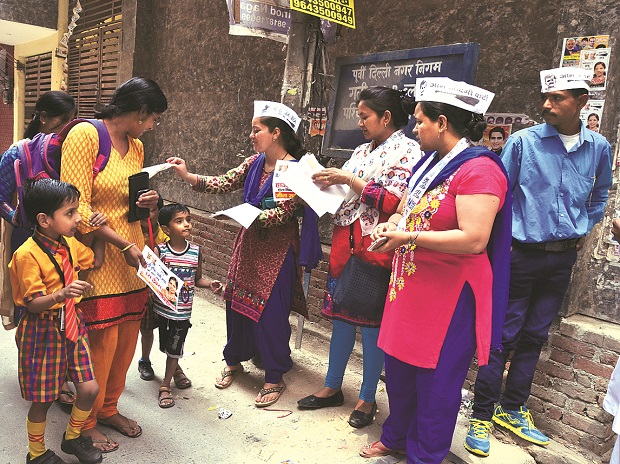
The BJP’s aggressive stance has forced AAP on the back foot. Instead of riding on Kejriwal’s popularity, the party has formed around 4,000 teams for door-to-door campaigning, is to reach at least four million households. These teams are to explain to people that most of the promises made before the Delhi assembly election in 2015 have been fulfilled. These include reducing power bills by half, providing free water supply up to 20,000 litres a month and free education loan up to Rs 10 lakh. 
The AAP government also raised the minimum wage for unskilled workers from Rs 9,724 to Rs 13,350 a month, for semi-skilled workers from Rs 10,764 to Rs 14,968 and for skilled workers from Rs 11,830 to Rs 16,182. The pension for senior citizens, persons with disability and widows was increased by Rs 1,000 a month. 

Friday, 7 April 2017

Samajwadi out, Mukhyamantri in: Yogi Adityanath orders UP schemes renamed

SP government had added the word to the development schemes in the state

 1490880621-134

Chief Minister Yogi Adityanath has directed the removal of the word 'Samajwadi' from various development schemes running in Uttar Pradesh, saying 'Mukhyamatri' should be used in its place.

"All the schemes in which the term Samajwadi is used should be presented before the cabinet so that they can be reviewed and the word should be replaced with Mukhyamantri," the CM said at a review meeting late last evening.

The previous SP government would typically add the word to the development schemes in the state. Even ambulances run under National Rural Health Mission (NRHM) were named Samajwadi Ambulance service.

Earlier, the BJP government had decided to not distribute over 60 lakh ration cards printed by the Akhilesh Yadav government as they featured a photograph of the former chief minister. (READ MORE)

Monday, 20 February 2017

Pihani, a cluster of villages near Lucknow, illustrates why the state has not developed

1487172652-0362
Pihani, Uttar Pradesh: For 16 years, Kailash Rai (not his real name), 49, has been commuting six hours every working day between his home in the state capital Lucknow and the government degree college where he teaches in Pihani, 135 km to the northwest.
A political-science lecturer, Rai cannot move with his family to Pihani, a cluster of over 100 villages (called a kasba) in Hardoi district, with less than 40,000 families as per Census 2011. When he started working there in 2000, it lacked the basic public facilities–regular power supply, good roads, public transport and good medical services.
Pihani remains an economic backwater. In the ongoing assembly elections, UP’s incumbent and contesting politicians are still promising the basic facilities they did 16 years ago: Electricity, buses and jobs, along with laptops and free data for poor youth.

UP ELECTION 2017 | story parallels that of Pihani. The kasba’s population of 206,743 is serviced by four colleges–a government degree college, a state-run industrial training institute (ITI) and two private degree colleges–more than the Indian average of 27 colleges per 100,000 youth in the 18-23 age group, according to the All India Survey on Higher Education (AISHE) 2014-15. But it has been unable to produce talent to run local educational institutions, banks and medical centres.
 has the highest number of colleges in any Indian state (6,026), according to AISHE 2014-15, but it has been unable to produce qualified workforce to drive development, as India Spend reported on February 11, 2017.
UP is India’s most populous and youngest state–its median age is 23–and the flaws in its development model typified by Pihani explain why its towns and village clusters (blocks with a population of less than 250,000 in 2011) cannot cope with the aspirations of its people, especially with regard to education and employment.
Pihani’s dropout rate of 36% at elementary school level exceeds UP’s overall rate of 21%. Like other village clusters in the state, connections to bigger cities are limited because there are few railway links, hardly any feeder roads to highways or efficient public transport services. Less than half the houses in the villages have electricity.

14th BRICS summit to review current global issues, reach key agreements

  At the   14th BRICS summit   which is to be hosted by China in a virtual mode on 23-24 June, the member nations will review the current gl...