Showing posts with label DIESEL PRICES. Show all posts

Friday, 1 April 2022

Petrol, diesel prices can rise by Rs 12, LPG by Rs 280 a cylinder: Nomura

 Besides the petrol, diesel and LPG prices, compounding the woes for manufacturers and consumers alike is the sharp hike in prices of natural gas starting April 1 for a period of six months
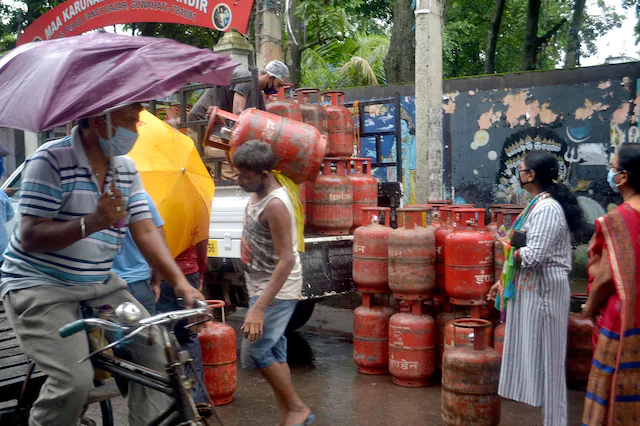
Petrol, diesel and LPG (liquefied petroleum gas) prices are set to burn a bigger hole in your wallet and upset the household budget over the next few weeks, warn analysts. Since March 22, petrol and diesel prices have risen cumulatively by around Rs 6.40-6.50 per litre (i.e., by 6.3 per cent and 7.1 per cent respectively), as of March 31.

“We expect further price hikes of Rs 12 for petrol and diesel price hike (this assumes global petrol/diesel prices of $132-136 a barrel, which corresponds to Brent crude oil price of $112 a barrel). LPG prices have been raised by Rs 50 per cylinder for a 14.2 kg cylinder (i.e., by around 5.5 per cent). Around Rs 280 per cylinder increase is still pending to avoid under-recoveries. This reflects higher commodity prices and escalation of other costs like shipping, insurance and logistics overheads,” wrote Sonal Varma, chief economist for India and Asia ex-Japan at Nomura in a recent co-authored note with Aurodeep Nandi.

Higher cost of fuel, including higher gas prices, will make transportation services expensive – railways, bus, taxi/auto rickshaw, school bus and air fares (the latter reflects prices of aviation turbine fuel. Cumulatively, transport services account for 2.45 per cent of the CPI (consumer price index) basket…

Monday, 2 September 2019

‘Best time to buy diesel car’: Companies pitch offers as BSVI norms near

Ahead of the BSVI norms that take effect on April 1, 2020, passenger vehicle makers are pulling out all stops to woo the buyers in a bid to beat the price hike of 8-15 per cent on diesel models
Buyers drive away from diesel cars as sales decline 9% from ratio in FY16
If someone is looking at buying a diesel car, there can’t be a better time. Ahead of the BSVI norms that take effect on April 1, 2020, passenger vehicle makers are pulling out all stops to woo the buyers in a bid to beat the price hike of 8-15 per cent on diesel models.
Based on the engine size and body type, the gap between the acquisition cost of a diesel vehicle and its gasoline counterpart, which is close to Rs 110,000 to Rs 115,000, is expected to go up to Rs 170,000 to Rs 200,000 once the new emission norms kick in.
Depending on the make and model, buyers of diesel variants can avail of several benefits ranging from a hefty exchange bonus, cash discounts, and extended warranty. The offers come amid one of the worst and prolonged slowdowns that the automobile industry is witnessing. Auto sales in India have been on a decline for the past 13 months. Companies are hoping to minimise the decline in volumes with the sales push during the festive season. The two-month-long festive season began with Ganesh Chaturthi on Monday.
“I think, this is best time to buy a BSIV diesel car,” said Shashank Srivastava, executive director, sales and marketing, Maruti Suzuki India. Rajan Wadhera, president automotive sector, Mahindra and Mahindra, also agreed. If one is looking to buy a diesel vehicle, personal or commercial, the time is now,” said Wadhera.

Thursday, 24 May 2018

'Petrol, diesel prices may stay high in immediate future': 10 points

Even as people across India see rising fuel prices burning a hole in their pockets, the price of petrol has touched Rs 85 a litre in Mumbai and Rs 77.17 a litre in Delhi

Excise duty on fuel may be cut by Rs 1-1.5 to ease retail prices of petrol

Petrol and diesel will continue to burn a hole in your pocket as Hindustan Petroleum Corporation Limited (HPCL) Chairman and Managing Director Mukesh Kumar Surana has told news agencies that fuel prices might remain high in the immediate future. Petrol prices in the country's financial capital, Mumbai, touched Rs 84.99 a litre on Wednesday, while the fuel's price inched higher to a new record of Rs 77.17 in Delhi. In Delhi, Kolkata, Mumbai, and Chennai, diesel was sold at Rs 68.34, Rs 70.89, Rs 72.76, and Rs 72.14 per litre, respectively.

As of Wednesday, one trigger after another had led to the 10th consecutive day of increase in retail selling price of petrol and diesel. As frustrations mounted across the country, Union Law & Justice, Electronics, and Information Technology Minister Ravi Shankar Prasad on Wednesday said that the Narendra Modi government was working on a long-term plan to tame fuel prices. "Instead of an ad-hoc measure, the government wants to have a long-term view that addresses not only volatility but also takes care of the unnecessary ambiguity arising out of frequent ups and downs," Prasad said.

The government has come under attack from the Opposition as fuel prices have gone up day after day. Former finance minister P Chidambaram claimed that the rates could be reduced by Rs 25 per litre but the government was not doing so. "It is possible to cut up to Rs 25 per litre, but the government will not. They will cheat the people by cutting price by Re 1 or Rs 2 per litre of petrol," he said in a Tweet.

Here are ten top points on rising petrol and diesel prices:

1) Congress protesting in Mumbai today as petrol nears Rs 85 a litre: The Congress targeted the Narendra Modi-led government at the Centre over high fuel prices, seeking to know why the petrol and diesel rates have gone up despite a fall in international crude oil prices. The party said it would hold a protest in Mumbai on Thursday over the matter. Mumbai Congress president Sanjay Nirupam said the residents of the city are paying the highest in the country for petrol and diesel.
Petrol prices in Mumbai touched Rs 84.99 a litre on Wednesday, while diesel was sold at Rs 72.76 per litre.

2) HPCL chief says review taxes on petrol, diesel: HPCL CMD Mukesh Surana on Wednesday said that there is a need to review taxation on petrol and diesel to provide relief to consumers. According to Surana, the solution has to be found while balancing the budgets of oil companies, the consumer, and the government.

3) 'Petrol, diesel prices might stay high in immediate future': In the immediate future, fuel prices might stay high, Surana told news agency ANI. He said that there is an Organization of the Petroleum Exporting Countries (OPEC) meeting scheduled to take place soon from where some triggers might come. "If OPEC countries increase production of oil, that could help fix the perception of high demand and less supply," he said.

Modi has an oil price headache and Saudi Arabia may just make it worse

Saudi Arabia is aiming for $80 to support the valuation of Saudi Aramco before an initial public offering

 Modi
 
India’s Prime Minister Narendra Modi has an oil problem. And it’s set to worsen with Saudi Arabia rooting for the commodity to push through the $80 barrier.

Modi’s government made the most of cheap oil by substituting any fall in prices with taxes that kept retail fuel rates unchanged for consumers and boosted the federal revenue. Now, pressure is mounting to forego some of that windfall as pump prices of gasoline and diesel hit records, likely marring the ruling party’s prospects at the national ballot in 2019.

“There is a strong case for the central government to take another excise duty cut, and ask state governments to reduce value added tax,” Anil Sharma and Ravi Adukia, analysts at Nomura Financial Advisory and Securities India Pvt. wrote in a note Tuesday.

Fuel prices have started to pinch as Brent, the benchmark for more than half of the world’s oil, hit $80 a barrel last week. It’s still short of its all-time high of $147.50. But cutting local taxes, which account for more than half of the retail gasoline and diesel prices, would stretch government finances at a time when the subsidy burden on kerosene and cooking gas is climbing.

Assuming an average oil price of $70, the fiscal 2019 subsidy would total about 355 billion rupees, or 105 billion rupees higher than budgeted, according to Kotak Institutional Equities. Meanwhile, Moody’s Investors Service estimates that fuel subsidies could total 340-530 billion rupees in fiscal 2019, the highest since fiscal 2015, if Brent crude oil prices average $60-$80 per barrel.

While Saudi Arabia has avoided pinpointing an exact price target for oil, Bloomberg reported citing people familiar with development that it is aiming for $80 to support the valuation of Saudi Aramco before an initial public offering.

Read More : Oil Price India 

14th BRICS summit to review current global issues, reach key agreements

  At the   14th BRICS summit   which is to be hosted by China in a virtual mode on 23-24 June, the member nations will review the current gl...
