Showing posts with label NASA. Show all posts

Thursday, 27 August 2020

NASA’s Hubble telescope maps giant Halo around Andromeda galaxy

They also found that the halo has a layered structure, with two main nested and distinct shells of gas. This is the most comprehensive study of a halo surrounding a galaxy
Andromeda galaxy
In a landmark study, scientists using NASA’s Hubble Space Telescope have mapped the immense envelope of gas, called a halo, surrounding the Andromeda galaxy, our nearest large galactic neighbour. Scientists were surprised to find that this tenuous, nearly invisible halo of diffuse plasma extends 1.3 million light-years from the galaxy — about halfway to our Milky Way — and as far as 2 million light-years in some directions. This means that Andromeda’s halo is already bumping into the halo of our own galaxy.
They also found that the halo has a layered structure, with two main nested and distinct shells of gas. This is the most comprehensive study of a halo surrounding a galaxy. The team’s findings appear in the recent edition of The Astrophysical Journal. “Understanding the huge halos of gas surrounding galaxies is immensely important,” said co-investigator Samantha Berek of Yale University in New Haven, Connecticut.


“This reservoir of gas contains fuel for future star formation within the galaxy, as well as outflows from events such as supernovae. It’s full of clues regarding the past and future evolution of the galaxy, and we’re finally able to study it in great detail in our closest galactic neighbour,” added Berek…Read Full Story

Monday, 2 December 2019

Nasa satellite finds debris of Chandrayaan-2 lander Vikram, releases pics

Vikram lost contact with Isro following its launch from Chandraayan-2 moon orbiter on September 6 when it tried to make a softlanding near the moon’s south pole
vikram lander
NASA has found the crash site and debris of India’s Chandrayaan-2 Vikram moon lander following a tip from an Indian space enthusiast who examined pictures of the area of the moon taken by a US orbiting camera.
The site was located by Shanmuga Subramanian, who on his own scoured the pictures taken by the Lunar Reconnaissance Orbital Camera (LROC), NASA and Arizona State University announced on Monday confirming the find. The first mosaic image of the likely crash site made from pictures taken by the LROC on September 17 was downloaded by several people to look for signs of the Vikram, NASA said.
Arizona State University (ASU), where the LROC project is located, said, “After receiving this tip the LROC team confirmed the identification by comparing before and after images.”One of them, Subramanian, contacted the LROC project with a positive identification of debris, it said. When the images for the first mosaic were acquired on September 17, the impact point was poorly illuminated and could not easily be identified, it said.
But two image sequences were acquired on October 14 and 15, and on November 11 were better. The university said that based on Subramanian’s tip, the LROC team scoured the surrounding area in the new mosaics and found the impact site and the debris field. The impact site is located at 70.8810 degree S, 22.7840 degrees E, at an elevation of 834 metres, it said….

Tuesday, 22 October 2019

NASA orbiter finds no trace of Chandrayaan-2 lander ‘Vikram’ on moon

On September 7, Indian Space Research Organisation (ISRO) attempted a soft landing of Vikram on the uncharted lunar south pole, before losing communication with the lander
NASA capture image of Vikram's landing site. Photo: NASA twitter
NASA has found no evidence of Chandrayaan-2’s Vikram lander in the images captured during a latest flyby of its Moon orbiter of the lunar region where India’s ambitious mission attempted a soft landing, the US space agency said. On September 7, Indian Space Research Organisation (ISRO) attempted a soft landing of Vikram on the uncharted lunar south pole, before losing communication with the lander.
“The Lunar Reconnaissance Orbiter imaged the area of the targeted Chandrayaan-2Vikram landing site on October 14 but did not observe any evidence of the lander,” Noah Edward Petro, the Project Scientist for the LRO mission, told PTI in an exclusive email interaction.
Petro said that the camera team carefully examined the images and employed the change detection technique — using a ratio of an image from prior to the landing attempt to the one acquired on October 14. This approach, he said, is used for finding new meteorite impacts on the Moon that also helped locate the recent Beresheet lander.
“It is possible that Vikram is located in a shadow or outside of the search area. Because of the low latitude, approximately 70 degrees south, the area is never completely free of shadows, John Keller, Deputy Project Scientist LRO Mission, told PTI….

Monday, 22 July 2019

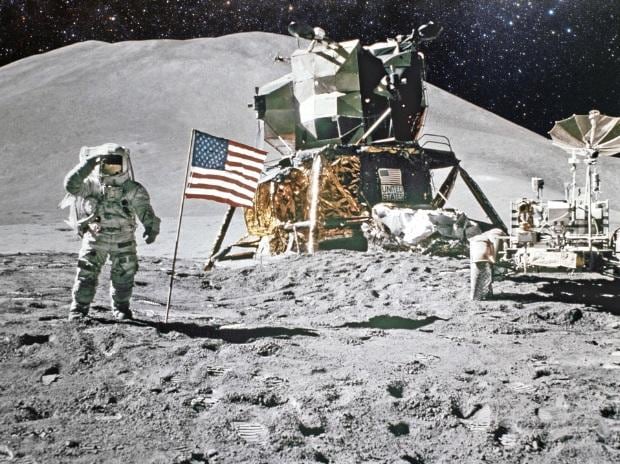
Apollo 11 made us believe we could do anything, but it could hasten our end

This faith in technology has given us a false sense of security
The Hasselblad Data Camera was fitted with a glass Reseau plate, which created cross marks on the images and made it possible to calibrate distances and heights enabling size-ratio analyses of objects on the moon. Photo: NASA
Current Affairs: The Apollo venture gave us the surprising exhibition of a blue marble ascending over the clean surface of the moon. Obviously, the moon was at that point known to be dreadful. In any case, being demonstrated something in high-goals shading photography establishes a more grounded connection than being told it by the specialists. Our planet showed up in the photographs as a little, powerless article in the midst of surroundings completely unfriendly to life. They appeared, such that no logical report could, the significance of keeping the Earth livable, boosting the ecological development.
However, the moon arrivals influenced numerous individuals in absolutely the contrary way. No other open undertaking has been such a dynamite achievement. The point was so basic and solid that everybody could quickly get a handle on it. Kennedy’s duty to “getting a man on the moon and returning him securely to the Earth” was made before the US had even put a man into space. However it was accomplished only eight years after the fact – scarcely a fraction of the time it takes these days to manufacture another railroad crosswise over London. “Top that,” the Americans can undoubtedly say. Fifty years on, nobody has.
The issue with tremendous victories is that they breed carelessness. The moon arrivals fortified the conviction that innovation will consistently have the option to tackle our issues. Everybody knows the maxim, “On the off chance that we can put a man on the moon, definitely we can… ” All we need is the will to do it. Also, a great deal of cash, obviously. In any case, not as much as you may might suspect: the whole Apollo program, more than 12 years, cost about £120 billion in the present cash. That is how much the US spends on its military in 11 weeks (and Britain in three years). On the off chance that innovation can do that, what can it not…
Read More :NASA Moon Mission

Sunday, 21 July 2019

50 yrs of Apollo 11: How geological maps made the moon landings worthwhile

Geological mapping continues today, even on bodies where there is no prospect of human visitors in the forseeable future
moon
Current Affairs: Regardless I recall an animation in a paper in July 1969, just before the main Apollo moon landing. It demonstrated the ground group reminding the space explorers as they boarded their rocket, “Remember to bring back some stone!” This was a gesture to an old occasion antique – individuals who went to the coastline were frequently approached to bring back some “stone”, alluding to shake sweets. It wasn’t amusing, however it demonstrates that, when the race against the Soviets was won, the purpose, all things considered, was to get some answers concerning the moon’s topography.
The logical benefit of arriving on the moon would have been reduced without concentrates to build up the setting of the arrival destinations. The essential thought was to contact down some place safe, however shakes gathered from these spots would have passed on substantially less data had exertion not gone into working out the idea of, and all the more significantly the connections between, the stone units from which the examples were gathered.
This was finished by making point by point land maps, utilizing similar rules that geologists use on Earth.
Cartography versus geographical mapping
Adjustable spectators had just started to draw general maps of the moon’s close side (which is everything that could possibly be seen from Earth) during the 1600s. These were basically practices in cartography, recording what the moon resembles. Before long names were being set apart to mark individual highlights, yet this was only an advantageous method to recognize them. It did not depend on any genuine comprehension.
On the other hand, geologists make maps to pick up knowledge into the historical backdrop of an area. They recognize tracts of territory of which the ages – and thusly perhaps inception and piece – can be found to appear as something else. This is normally accomplished by working out what is over what (more youthful layers will for the most part be over more seasoned layers) and cross-cutting connections (more youthful highlights can cut crosswise over more established ones, however not the other way around)…
Read Full Story: 50 Years of Apollo 11

Thursday, 18 July 2019

Women yet to step on moon but well intertwined with it in literature

The moon is often envisaged as a female entity, which inspired poems on the theme of her gaze as she looks down on Earth benignly
Moon Rise
Current Affairs: In the late 17th century, the female English playwright Aphra Behn wrote a smash hit play about a man obsessed with the moon, who was constantly travelling there in his imagination. Exactly 282 years later, Neil Armstrong and Buzz Aldrin actually made that dream a reality.
Their astonishing achievement on July 20, 1969 led some to worry that the moon would become an object of purely scientific study – a barren and lifeless body, no longer a source of romantic inspiration. Fortunately, this fear did not come to pass.
For example, in the year that marked the 40th anniversary of the landings ten years ago, the then poet laureate Carol Ann Duffy edited To the Moon: An Anthology of Lunar Poems which gathered together works from ancient to modern, and included her own poem, The Woman in the Moon.
And while no woman has yet stepped on to this celestial body, women have long been associated with the moon – with its tidal pull, and the binary thinking that places it secondary in majesty to the sun. It is no wonder, then, that the moon has stimulated some incredible literature by female writers.
The moon is often envisaged as a female entity, which inspired poems on the theme of her gaze as she looks down on Earth benignly. Way back in antiquity, the Greek poet Sappho did just this in her short song describing how:
When, round and full, her silver face, Swims into sight, and lights all space. This trope continued for millennia and into the 19th century. Louisa May Alcott (author of Little Women) wrote The Mother Moon in 1856, imagining a benevolent maternal moon looking down on the Earth, occasionally hidden but ultimately undiminished by clouds. Also in the 19th century, American poet Emily Dickinson’s moon similarly shone “Her perfect Face Upon the World below”.

Tuesday, 14 May 2019

Moon is shrinking like a ‘raisin’, triggering wrinkles and quakes: Nasa

Accordingly, the Moon has turned out to be around 150 feet (50 meters) “skinnier” in the course of the last a few hundred million years
Moon
The Moon is consistently contracting, causing wrinkling on its surface and shudders, as per an investigation of symbolism caught by NASA’s Lunar Reconnaissance Orbiter (LRO) distributed Monday. An overview of in excess of 12,000 pictures uncovered that lunar bowl Mare Frigoris close to the Moon’s north shaft – one of the numerous immense bowls since quite a while ago thought to be dead locales from a topographical perspective – has been splitting and moving.
In contrast to our planet, the Moon doesn’t have structural plates. Rather, its structural movement happens as it gradually loses heat from when it was framed 4.5 billion years prior. This thusly makes its surface wrinkle, like a grape that wilts into a raisin. Since the moon’s covering is weak, these powers cause its surface to break as the inside therapists, bringing about purported push deficiencies, where one segment of outside is pushed up over a contiguous segment.
Thus, the Moon has turned out to be around 150 feet (50 meters) “skinnier” in the course of the last a few hundred million years. The Apollo space explorers initially started estimating seismic action on the Moon during the 1970s, finding most by far were happened somewhere down in the body’s inside while a more modest number were on its surface.
The investigation was distributed in Nature Geoscience and inspected the shallow moonquakes recorded by the Apollo missions, setting up connections among them and extremely youthful surface highlights. “All things considered, the issues are as yet dynamic today,” said Nicholas Schmerr, an associate educator of geography at the University of Maryland who co-wrote the examination. “You don’t frequently get the opportunity to see dynamic tectonics anyplace yet Earth, so it’s energizing to figure these flaws may even now be delivering moonquakes..

Tuesday, 16 October 2018

Nasa wants to send humans to Venus – now that’s brilliant idea; here’s why

The idea behind NASA’s new mission is not to land people on the inhospitable surface, but to use the dense atmosphere as a base for exploration
Nasa
Popular science fiction of the early 20th century depicted Venus as some kind of wonderland of pleasantly warm temperatures, forests, swamps and even dinosaurs. In 1950, the Hayden Planetarium at the American Natural History Museum were soliciting reservations for the first space tourism mission, well before the modern era of Blue Origins, SpaceX and Virgin Galactic. All you had to do was supply your address and tick the box for your preferred destination, which included Venus.
Today, Venus is unlikely to be a dream destination for aspiring space tourists. As revealed by numerous missions in the last few decades, rather than being a paradise, the planet is a hellish world of infernal temperatures, a corrosive toxic atmosphere and crushing pressures at the surface. Despite this, NASA is currently working on a conceptual manned mission to Venus, named the High Altitude Venus Operational Concept – (HAVOC)..read more
Hovering in the atmosphere
Luckily, the idea behind NASA’s new mission is not to land people on the inhospitable surface, but to use the dense atmosphere as a base for exploration. No actual date for a HAVOC type mission has been publicly announced yet. This mission is a long term plan and will rely on small test missions to be successful first. Such a mission is actually possible, right now, with current technology. The plan is to use airships which can stay aloft in the upper atmosphere for extended periods of time.

Source :  Business Standard OR  BS 

Wednesday, 8 November 2017

'Flying taxis' by 2020? Uber strikes deal with Nasa to make it a reality

Uber had previously unveiled its plans to introduce flying taxi fleets, known as uberAIR, reported CNN


3825.jpg 
 
Uber is a step closer in making its flying taxi plans a reality as it has signed a deal with National Aeronautics and Space Administration (NASA) to develop an air traffic management system.

Uber said at the Web Summit tech conference in Lisbon that it signed a Space Act Agreement with NASA for the development of "unmanned traffic management."

Uber had previously unveiled its plans to introduce flying taxi fleets, known as uberAIR, reported CNN.

Uber is already testing another emerging technology, self-driving cars, in various cities around the country, according to the reports.(technology news)

This is the start-up's first partnership with a U.S. federal government agency.

Uber's partnership is part of NASA's Space Act Agreement, a consortium of industry players working to ensure "safe and efficient operations" of its taxis and other small unmanned aerial systems flying at low altitudes.

Uber plans to trial the project in Los Angeles in 2020 along with the already announced cities Dallas and Dubai, the company said.

It is also hopeful of having commercial operations ready in time for the 2028 Olympics in Los Angeles, the report added.


14th BRICS summit to review current global issues, reach key agreements

  At the   14th BRICS summit   which is to be hosted by China in a virtual mode on 23-24 June, the member nations will review the current gl...