Showing posts with label LPG. Show all posts

Friday, 1 April 2022

Petrol, diesel prices can rise by Rs 12, LPG by Rs 280 a cylinder: Nomura

 Besides the petrol, diesel and LPG prices, compounding the woes for manufacturers and consumers alike is the sharp hike in prices of natural gas starting April 1 for a period of six months
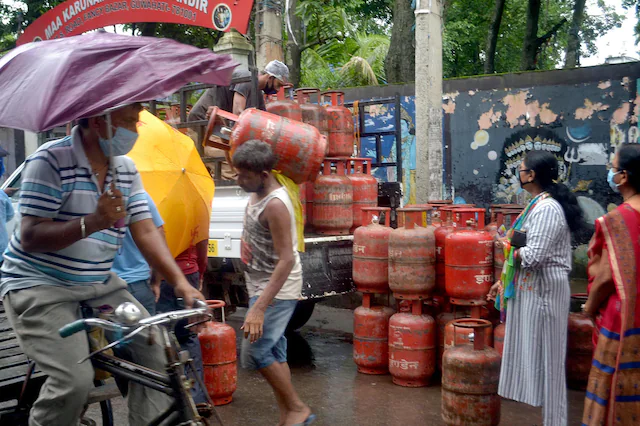
Petrol, diesel and LPG (liquefied petroleum gas) prices are set to burn a bigger hole in your wallet and upset the household budget over the next few weeks, warn analysts. Since March 22, petrol and diesel prices have risen cumulatively by around Rs 6.40-6.50 per litre (i.e., by 6.3 per cent and 7.1 per cent respectively), as of March 31.

“We expect further price hikes of Rs 12 for petrol and diesel price hike (this assumes global petrol/diesel prices of $132-136 a barrel, which corresponds to Brent crude oil price of $112 a barrel). LPG prices have been raised by Rs 50 per cylinder for a 14.2 kg cylinder (i.e., by around 5.5 per cent). Around Rs 280 per cylinder increase is still pending to avoid under-recoveries. This reflects higher commodity prices and escalation of other costs like shipping, insurance and logistics overheads,” wrote Sonal Varma, chief economist for India and Asia ex-Japan at Nomura in a recent co-authored note with Aurodeep Nandi.

Higher cost of fuel, including higher gas prices, will make transportation services expensive – railways, bus, taxi/auto rickshaw, school bus and air fares (the latter reflects prices of aviation turbine fuel. Cumulatively, transport services account for 2.45 per cent of the CPI (consumer price index) basket…

Monday, 4 March 2019

Ujjwala leads to 40 mn new LPG connections with a jump of 45% in FY19

The rising number of Ujjwala customers is, however, increasing the government’s subsidy burden
Image result for Ujjwala leads to 40 mn new LPG connections with a jump of 45% in FY19
Economy News: The push for clean energy through the Pradhan Mantri Ujjwala Yojana (PMUY) has led to a record 40.7 million new liquefied petroleum gas (LPG) connections being added in the current fiscal year (2018-19, or FY19). This is a jump of 45 per cent over 2017-18 (FY18). The three oil marketing companies — Indian Oil Corporation (IOC), Bharat Petroleum Corporation, and Hindustan Petroleum Corporation (HPCL) — have together set a target of adding 42.5 million customers by the end of March 31.
The rising number of Ujjwala Yojana customers is, however, increasing the government’s subsidy burden. The LPG subsidy during the first nine months of the current fiscal year has already crossed the last year’s mark by 23 per cent.
The government shelled out Rs 25,700-crore subsidy during April-December 2018, compared to Rs 20,880 crore during the whole of FY18. The Budget for 2019-20 had, however, provided only Rs 20,283 crore in the Revised Estimates for FY19. The government expects the LPG subsidy to rise 62 per cent to Rs 32,989 crore next year. A part of this is expected to be rolled over from the current year…

Thursday, 3 August 2017

Prices of subsidised LPG zoom 16 per cent since Modi took charge

Global crude oil prices have slumped by 49 per cent during the same period
LPG prices slumped by 49%
The prices of subsidised cooking gas zoomed by 16 per cent, from Rs 414 per cylinder when the Bharatiya Janata Party (BJP) government came to power in May 2014 to Rs 479.77 in August 2017, despite global crude oil prices dipping by about 49 per cent.

The Narendra Modi-led government had stormed to power in 2014 on the back of serious corruption charges against the Congress-led regime and the rise in prices of commodities like cooking gas, against which the BJP had raised its voice. Interestingly, the price of liquefied petroleum gas (LPG) was revised 22 times by oil marketing companies (OMCs) like Indian Oil Corporation (IOC), Bharat Petroleum Corporation (BPCL), and Hindustan Petroleum Corporation (HPCL) since May 2014, when the BJP government took charge.

However, on the back of a 49 per cent drop in international crude prices, from $102.71 a barrel on May 30, 2014, to $52.16 (Brent crude) on August 3, 2017, prices of non-subsidised cylinders dipped 44 per cent, from Rs 928.50 per cylinder in May 2014 to Rs 524 in August 2017.

#Economynews

Also, in an effort to reduce the subsidy burden or to completely do away with the subsidy, OMCs are authorised to increase prices of subsidised domestic LPG cylinders by Rs 4 per month till March 2018. "The government stands committed and will continue to provide subsidy assistance to the needy and poor households," said an official close to the development.
The subsidy amount on a 14.2-kg cylinder transferred to the accounts of Delhi consumers stands at Rs 86.54 currently, which the government wants to do away with or reduce to the range of Rs 40 per cylinder by March 2018. The current national average of LPG subsidy per cylinder comes to the tune of about Rs 58 per cylinder.

>>>READ MORE<<<

Tuesday, 4 July 2017

Congress demands roll back of 5% GST on LPG cylinder

LPG has been put in 5% GST slab, earlier a 2 to 4% VAT was imposed on LPG in some states

Empty Liquefied Petroleum Gas (LPG) cylinders are seen at a gas distribution centre at Dujana village in Noida (Photo: Reuters)


The Congress on Tuesday demanded that the five per cent Goods and Services Tax (GST) levied on domestic LPG cylinder be removed as it was burdening the poor.

"The price of domestic LPG cylinder has gone up by Rs 32 in parts of the country after the GST became effective. This is affecting common people, the poor especially. We demand that the GST on domestic LPG cylinder be removed immediately," senior AICC spokesperson Ajay Maken told reporters here.

LPG has been put in the five per cent GST slab. Earlier a two to four per cent VAT was imposed on LPG in some states.(Economy news)

Maken accused the government of not passing on the benefits of drop in global crude oil prices to people of the country.

"The government is making profits to the tune of Rs 3 lakh crore every year by not slashing prices of fuel here. On the one hand, it is making profits and on the other, it is burdening the poor by imposing GST on the LPG cylinder," Maken added.

He claimed food and beverages, helmets, hair oil, tooth paste, tea, coffee, butter, curd, cement and mineral water are some of the items prices of which have shot up, notwithstanding the government's assurance that their rates will drop once the GST is in force.

Maken also described the GST as 'Gayi Savings Tumhari' (your savings have vanished).

The GST came into force on July 1.

(Only the headline and picture of this report may have been reworked by the Business Standard staff; the rest of the content is auto-generated from a syndicated feed.)

14th BRICS summit to review current global issues, reach key agreements

  At the   14th BRICS summit   which is to be hosted by China in a virtual mode on 23-24 June, the member nations will review the current gl...