Showing posts with label SMARTPHONES. Show all posts

Thursday, 29 August 2019

Apple to start online sales in India soon with local sourcing rules eased

The new investment rules could provide a boost to Apple, allowing it to grow sales in the country and possibly help it reduce its dependency on China by building an alternative supply chain in India
Apple
International News: Apple Inc is poised to start online sales of its devices in India within months, a person familiar with the matter said, benefiting from new rules making the world’s fastest-growing smartphone market more attractive to foreign brands.
On Wednesday, India eased rules that forced companies such as Apple to source 30% of their production locally — a requirement the iPhone maker has been lobbying against for years — to include exports as part of the requirement.
That rule posed a problem for electronics brands because most of its devices and components are manufactured in China. The government also allowed so-called single brand retailers to set up online stores before physical shops.
With escalating trade tensions damaging ties between the US and China, New Delhi’s latest investment rules could provide a boost to Apple, allowing it to grow sales in the country and possibly help it reduce its high dependency on China by building out an alternative supply chain in India.
The Cupertino, Calif-based device and services company will begin selling its iPhone, iPads and Apple Mac computers online in the coming months. It’s also firming up the Mumbai location of its first company-owned brick & mortar store in India — likely to open next year — the person said, asking not to be identified as the details are confidential. Selling online will be a big step forward for Apple in a country where counterfeit products abound in online platforms increasing buyers’ distrust….

Tuesday, 28 August 2018

HMD gets iconic Nokia PureView trademark: Camera-centric phone in offing?


In 2012, Nokia introduced the Nokia 808 PureView, a camera-centric smartphone with a mammoth 41-megapixel primary lens, coupled with several industry-first camera-centric features


HMD Global


Technology News : HMD Global, the Finnish mobile phone manufacturer behind the Nokia-branded devices, has acquired the rights to use the PureView trademark, according to a report by technology portal GSMArena, which has cited a listing of the European Intellectual Property Office (EUIPO). This could mean that the Finnish company might be working on a camera-centric flagship smartphone that could resurrect Nokia’s PureView series.

In retrospect, the PureView was once a trademark of Nokia’s camera-centric smartphones. In 2012, the Finnish company introduced the Nokia 808 PureView smartphone with a mammoth 41-megapixel primary camera, coupled with several industry first camera-centric features such as optical image stabilisation, ND filter, mechanical shutter, bright Xenon flash and ability to save photos in RAW format. These features revolutionised the smartphone industry and marked the beginning of camera-centric smartphones. This was followed by other smartphone brands such as Samsung, Sony and HTC.

The Nokia 808 PureView remained the best camera smartphone for several years after its launch. However, marred by a declining market share, given Nokia's dependency on an obsolete operating system when compared with Android and iOS, the company sold off the smartphone business to Microsoft. In 2013, Microsoft also resurrected the PureView trademark with the launch of the Nokia 1020. This phone also featured a 41MP primary camera, along with OIS and Xenon flash, and ran on Microsoft Windows Phone-based operating system. This operating system lacked application support, which led to the sluggish demand for the otherwise capable camera-centric smartphone.

Keep reading : BS

Friday, 11 May 2018

Alexa & Siri can hear this command. You can't

Researchers can now send secret audio instructions undetectable to the human ear

 Which voice do you want in your fridge? Makers pick virtual assistants


Many people have grown accustomed to talking to their smart devices, asking them to read a text, play a song or set an alarm. But someone else might be secretly talking to them, too.

Over the past two years, researchers in China and the United States have begun demonstrating that they can send hidden commands that are undetectable to the human ear to Apple’s Siri, Amazon’s Alexa and Google’s Assistant. Inside university labs, the researchers have been able to secretly activate the artificial intelligence systems on smartphones and smart speakers, making them dial phone numbers or open websites. In the wrong hands, the technology could be used to unlock doors, wire money or buy stuff online — simply with music playing over the radio.

A group of students from University of California, Berkeley and Georgetown University showed in 2016 that they could hide commands in white noise played over loudspeakers and through YouTube videos to get smart devices to turn on airplane mode or open a website.

This month, some of those Berkeley researchers published a research paper that went further, saying they could embed commands directly into recordings of music or spoken text. So while a human listener hears someone talking or an orchestra playing, Amazon’s Echo speaker might hear an instruction to add something to your shopping list.

“We wanted to see if we could make it even more stealthy,” said Nicholas Carlini, a fifth-year PhD student in computer security at U C Berkeley and one of the paper’s authors.

Carlini added that while there was no evidence that these techniques have left the lab, it may only be a matter of time before someone starts exploiting them.

These deceptions illustrate how artificial intelligence — even as it is making great strides — can still be tricked and manipulated. Computers can be fooled into identifying an airplane as a cat just by changing a few pixels of a digital image, while researchers can make a self-driving car swerve or speed up simply by pasting small stickers on road signs and confusing the vehicle’s computer vision system.

With audio attacks, the researchers are exploiting the gap between human and machine speech recognition. Speech recognition systems typically translate each sound to a letter, eventually compiling those into words and phrases. By making slight changes to audio files, researchers were able to cancel out the sound that the speech recognition system was supposed to hear and replace it with a sound that would be transcribed differently by machines while being nearly undetectable to the human ear.

The proliferation of voice-activated gadgets amplifies the implications of such tricks. Smartphones and smart speakers that use digital assistants such as Amazon’s Alexa or Apple’s Siri are set to outnumber people by 2021, (Technology)according to the research firm Ovum. And more than half of all American households will have at least one smart speaker by then, according to Juniper Research.

Amazon said that it doesn’t disclose specific security measures, but it has taken steps to ensure its Echo smart speaker is secure. Google said security is an ongoing focus and that its Assistant has features to mitigate undetectable audio commands. Apple said its smart speaker, HomePod, is designed to prevent commands from doing things like unlocking doors, and it noted that iPhones and iPads must be unlocked before Siri will act on commands that access sensitive data or open apps and websites, among other measures.

The technique, which the Chinese researchers called DolphinAttack, can instruct smart devices to visit malicious websites, initiate phone calls, take a picture or send text messages. While DolphinAttack has its limitations, experts warned that more powerful ultrasonic systems were possible.

That warning was borne out in April, when researchers at the University of Illinois at Urbana-Champaign demonstrated ultrasound attacks from 25 feet away. While the commands couldn’t penetrate walls, they could control smart devices through open windows from outside a building.
Carlini said he was confident that in time he and his colleagues could mount successful adversarial attacks against any smart device system on the market.


Tuesday, 17 April 2018

The researchers noted that digital addiction is not our fault but a result of the tech industry's desire to increase corporate profits

1522945170-712.jpg 

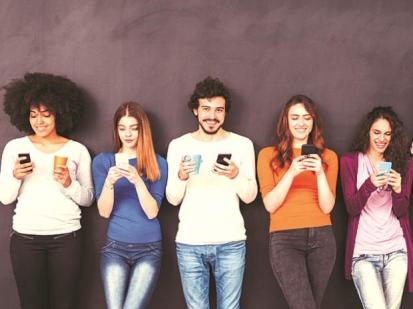
People addicted to smartphones are more likely to feel depressed, anxious and lonely, a study has found.

Researchers said that overuse of smartphones is just like any other type of substance abuse.

"The behavioural addiction of smartphone use begins forming neurological connections in the brain in ways similar to how opioid addiction is experienced by people taking Oxycontin for pain relief - gradually," said Erik Peper from San Francisco State University in the US.

In a survey of 135 students, the researchers have found that students who used their phones the most reported higher levels of feeling isolated, lonely, depressed and anxious.

According to the study, published in the journal NeuroRegulation, they believe the loneliness is partly a consequence of replacing face-to-face interaction with a form of communication where body language and other signals cannot be interpreted.

The researchers also found that those same students almost constantly multitasked while studying, watching other media, eating or attending class.

This constant activity allows little time for bodies and minds to relax and regenerate, said Peper, and also results in "semi-tasking," where people do two or more tasks at the same time - but half as well as they would have if focused on one task at a time.

The researchers noted that digital addiction is not our fault but a result of the tech industry's desire to increase corporate profits.

"Push notifications, vibrations and other alerts on our phones and computers make us feel compelled to look at them by triggering the same neural pathways in our brains that once alerted us to imminent danger, such as an attack by a tiger or other large predator," Pepper said.

But, according to the researchers, we can take charge and train ourselves to be less addicted to our phones and computers.

The first step is recognising that tech companies are manipulating our innate biological responses to danger.

Peper suggested that we should turn off push notifications, only respond to email and social media at specific times to focus on important tasks.

Article source: Business standard

14th BRICS summit to review current global issues, reach key agreements

  At the   14th BRICS summit   which is to be hosted by China in a virtual mode on 23-24 June, the member nations will review the current gl...